Robert's own contribution is really neat -- the Wonder Woman drawing below.

 This is the latest installment of a series of pictures I call The Comics Re-covery Project. I choose comic book covers I like and redraw them in my own style as a learning exercise. The cover design strategy employed here is one I call A Bunch of Heroes Standing Around Doing Nothing. It's actually used a lot in comics of the last two decades. Yes, they're just loitering, but the looks on their faces say, "As soon as we're done posing for this picture, we are really gonna kick some butt!"
 This is something I did when I was a senior in high school. It was for our school's literary magazine. For a rural school in 1983, it was a very sharp little magazine. Since it was called Expressions, I did extreme close-ups of a few celebrities. See if you can find Tom Selleck, Richard Pryor, and Bo Derek. I can't remember the rest of them.

 I think it's really sad that Andrew Wyeth died today at the age of 91. You wouldn't know it by looking at the art you see here, but he has always been one of my favorite artists. Of course, much more serious than the work I do. What I most admire about his work is that they aren't just people of people places and things. Every image means something -- it is so full of meaning.
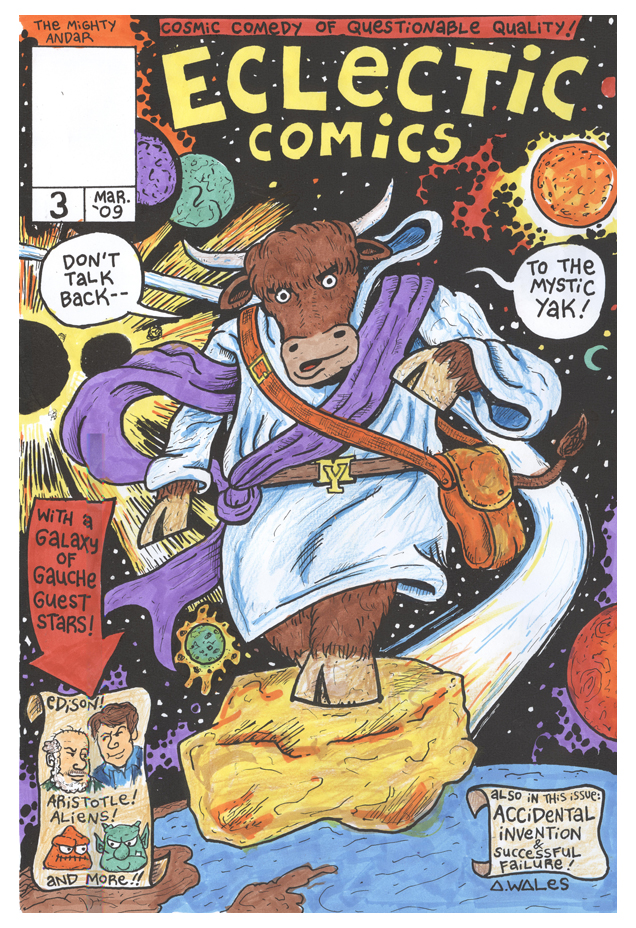 Hurtling through the cosmos on a meteor rides the Mystic Yak. The cover is drawn with ink, and I'm going to color it with Photoshop, but I thought first I'd color a copy by hand to see if I could make my color choices before hand. I'll use this color sketch as a guide while I try to teach myself Photoshop.
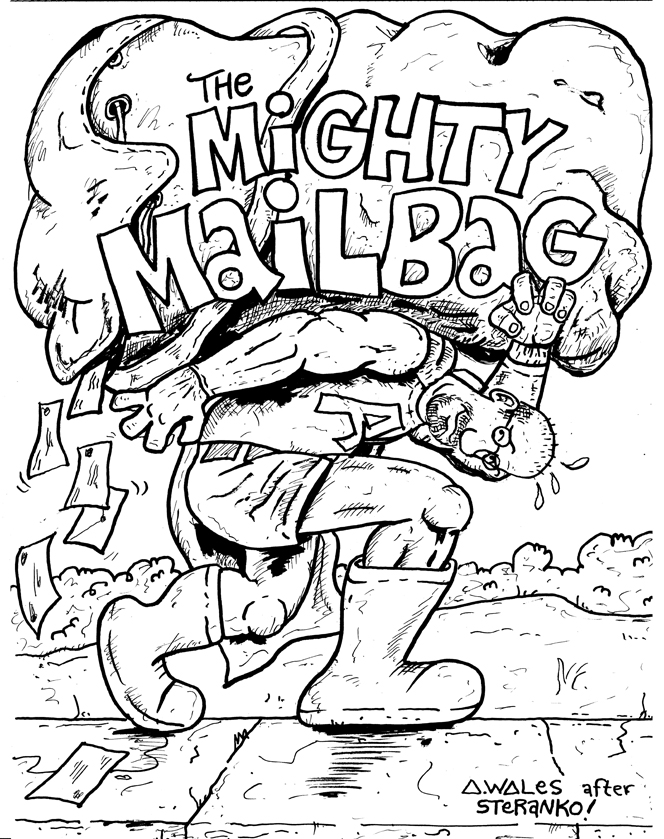
 This classic Steranko cover is one of the most famous Hulk images. The one below is one used in a recent Incredible Hercules comic. They look a lot alike don't they? Is it a swipe or a tribute?
Comic book covers based upon famous images, from other comics or elsewhere, areI think the whole idea is great, but I also think that certain images end up being over-used, and the Steranko Hulk cover is one of them. Not wanting to be left out, I've decided to use it as the image for the next Mighty Mailbag page.
commonly referred to as “homage covers”. As the term implies, homage covers pay tribute to revered “touchstones” of comic book, pop cultural or even “real world” historical imagery. They also provide a sense of fun and community, as seasoned fans recognize the visual as the hat-tip, the nod, the gentle satire or the arcane “in-joke” knowledge it was intended to be.


Your reticular activating system is like a filter between your
conscious mind and your subconscious mind. It takes instructions from your
conscious mind and passes them on to your subconscious. For example, the
instruction might be, "listen out for anyone saying my name".
...you can deliberately program the reticular activating system by
choosing the exact messages you send from your consicous mind. For example, you
can set goals, or say affirmations, or visualize your goals.
 The image above is the first drawing I had published. Before you judge it too severely, keep in mind that I was in sixth grade! Back in the days before copiers, schools used ditto machines. The ditto machine (or spirit duplicator) used two-ply "ditto masters". The first sheet could be typed, drawn or written on. The second sheet was coated with a layer of colored wax. Writing on the first sheet created a mirror image on the back of it. The first sheet was fastened on the drum and copies could be printed -- in our school, usually in blue. I remember getting those worksheets hot of the presses and taking a deep whiff of the rapturously fragrant aromatic ink. Maybe that explains a lot.
 Well, suffice it to say, children weren't usually allowed to write or draw on ditto masters. One day in sixth grade, a teacher put one of those masters on my desk and asked me to design a cover for the Spring Concert Program. I didn't really cut loose too much because I was afraid of messing it up. I can remember being thrilled to see a stack of the programs and knowing that my drawing was on every one of them! And then, looking out at the sea of faces at the concert and seeing that everyone in the audience had my drawing in their hands. This could be where I got bit by the publishing bug. The only other thing I remember about the night is that we sang "Blowing in the Wind" by Bob Dylan.
Some people think comics are just for kids. Others think that comics for adults is a relatively new thing. When I researched the history of comics for my master's research project, I learned that they were quite popular with men in the armed services during World War II. It was said that they were “passed from man to man until there is nothing left of them” (Zorbaugh, page 198). The New York Times reported that during wartime, one of every four magazines shipped to troops overseas was a comic book (Wright, 2001). I just recently saw these photos online, and wished that I had found them when I was working on my research project In Defense of Comics.

Wright, Gary. (1979). “The comic book – a forgotten medium in the classroom.” Reading Teacher 33(2). Pgs. 158-161.
Zorbaugh, Harvey (1944). The comics – there they stand! Journal of Educational Sociology 18 (4). Pp. 196-203.