
I was challenged to draw a pirate, but since I was drawing during the debates, all I could think of were donkeys and elephants fighting over the treasure. Here's the first one, but don't worry -- a donkey will soon follow!
 I hear that it's common for bloggers to feel as if they're sometimes talking to an empty room. That's why it's really nice to hear from someone who says they've gotten something useful from what you've written. Yesterday I heard from someone in California! They wrote,
The internet has definitely made the world a smaller place, hasn't it? And, I'm more than glad to share anything I make with other teachers who are looking for ways to teach with comics or art!Hello and Happy New Year! I work for the literacy department of STAR Education, an afterschool organization. The sites my department primarily services are in Los Angeles public schools and students attend free of charge.We aim to provide positive and authentic experiences with reading and writing. In addition to our skills curriculum, our teachers implement enrichment projects in ten-week sessions. The upcoming curriculum is "Clever Comics."Your blog has been very informative. Thank you! I'm wondering if you have any suggestions for our curriculum. I'm open to all suggestion, and have particular questions about teaching dialogue and narration.Your link to and examples of 52comicchallenges.com have also helped us in our curriculum development. Would it be alright if we gave copies to our teachers to share with their classes?
-- Aarti, CA
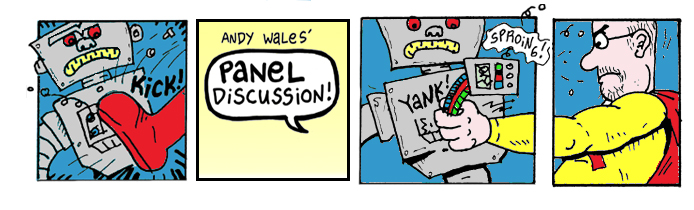
 Nathan's favorite toy from Christmas is his Superman action figure. He also insists on wearing his Superman jammies whenever he sees them, whether it's time for bed or not. He doesn't call him by name, though. All superheroes are called "B", but this one goes "Whish!" when he flies.
MOLESKINE is the legendary notebook that has held the inspirations and ideas of everyone from Van Gogh, Picasso and Hemingway to famed author, Bruce Chatwin. Artists, authors, and geniuses of all variety have long appreciated the simplicity and superior functionality of these notebooks.It looks like I'm in good company! I tried it out tonight while I was waiting at the mall. It is very nice paper and a nice sturdy but flexible sketchbook. I'm thinking Mondays will be Moleskine Mondays, and I'll post a recent sketch from the sketchbook. My New Year's resolution is to try to make better use of the time I spend just waiting (at the doctor's office, etc.) and I'm going to try to keep this baby with me!
Originally these books were produced by small French bookbinders who supplied the Parisian stationery shops frequented by the international avant-garde. However, In 1986, the last manufacturer of Moleskine, a family operation in Tours, closed and Moleskines were gone – but not forgotten. As a result of their previous popularity and demand, they did return. In 1998, a small Milanese publisher brought these books back for writers, artists, travelers and all free-thinkers around the globe.


Some parents and teachers regard comics, with their sentences jammed into bubbles and their low word-to-picture ratio, as part of the problem when it comes to low reading scores and the much-lamented decline in reading for pleasure. But a growing cadre of educators is looking to comics as part of the solution.This is no news to me and to many others who learned to read by reading comics, but it's great to see the Establishment coming around.
"It's very much a teacher-led kind of movement in that teachers are looking for ways to engage their children, and they're finding some of that in comic books," said Michael Bitz, who founded the Comic Book Project as a graduate student and is now its director. "For kids who may be struggling and for kids who may be new to the English language, that visual sequence is a very powerful tool."


