Showing posts with label School Stuff. Show all posts

Friday, March 26, 2010

James Warhola Visit

Our school recently had a visit from author/illustrator James Warhola. Here we are posing by a sculpture created by fifth graders of his uncle, Andy Warhol.


After his slide show and reading, it was a real treat to see a lot of his original art up close. He brought finished illustrations, sketches and "dummies" (prototypes of books before the finished art is begun).
You can read more about this fantastic day at my teacher blog.

Saturday, December 26, 2009

The Artistes (pronounced \är-ˈtēsts\)

This is the Mansfield University art department faculty and staff, where I will be a part-time instructor next fall (in addition to my day job!). We are supposed to be posing for the yearbook. It is a very positive, creative and sometimes zany bunch. I think I will fit in pretty good.

Wednesday, November 4, 2009

Life Imitates Art?


Here I am with my friend Rich Macik, who happens to be dressed as a giant chicken. This is during the school Halloween parade. Regular readers may recall that the Mighty Andar Recently battled a six foot chicken. This goes to show -- be careful what you visualize, because many times these things come to pass!

Saturday, October 24, 2009

Comix by Kids

Issue #1 of this comic is now in print! Every year, each of my fifth grade students creates their own character and makes a one-page comic strip. Last year, I chose the 24 best strips and had them published through a print-on-demand publishing company called Ka-blam. The comic looks really sharp and I think the kids will be excited to see their work in print.


Thursday, October 15, 2009

My Trip to Where the Wild Things Are

I've been reading this classic book by Maurice Sendak to my first and second grade students. They're excited about the movie, and so am I -- but movies like this are always better when you've read the book first.

After reading the story, I ask them to put themselves in the story. What do they think would happen if they went to Where the Wild Things Are. They're still working on their stories and drawings, but mine is finished, below. Later this week I'll post some of theirs on my teacher website. They're looking great!

Thursday, October 8, 2009

It's All About Me!

The kids in the classroom across the hall were making these posters that were "all about them". They looked fun, so I asked if I could make one too. (Why should the kids have all the fun?) Here are some pieces of my finished poster.


Saturday, May 16, 2009

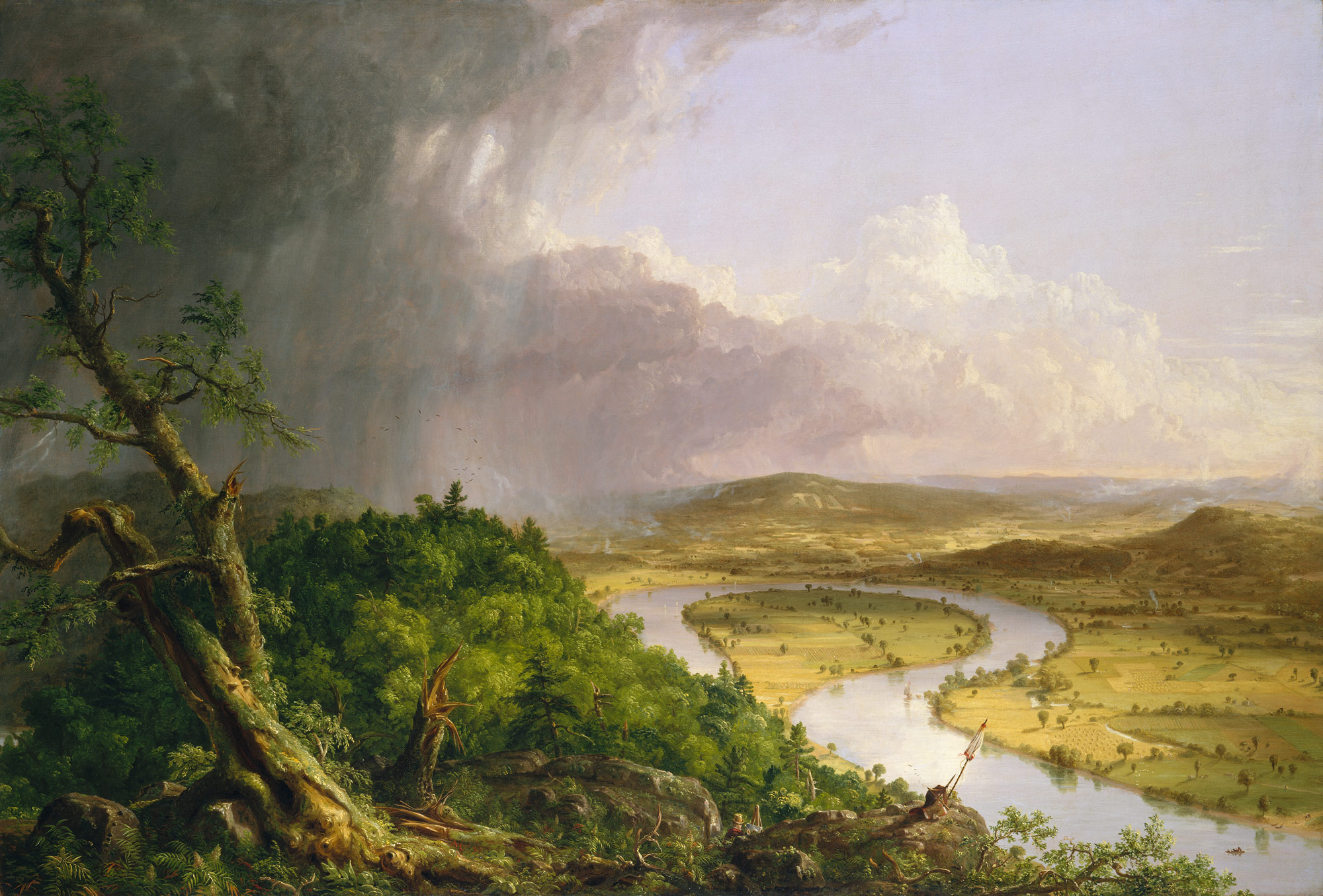
"The Oxbow" by Thomas Cole

The school where I teach was recently fortunate enough to be recipient of one of the Picturing America grants from the National Endowment of the Humanities (NEH). Through this grant they provide schools with huge, beautiful reproductions of masterpieces of American art, as well as a teacher's guide book that provides ideas on how to use the reproductions to teach concepts from history and art.

This painting can almost be divided in half, with the left side an untamed wilderness. A storm is passing through towards the left with lightning and dark clouds. On the right side, the storm has passed and everything is calm. It is an ideal rural scene, but the removal of trees has left scars on the hillside. On closer inspection, those scars are in the shape of Hebrew letters. From man's view, they spell Noah. Looking down, from God's perspective, they same shapes spell Shaddai, or the Hebrew word for God, or Almighty. The NEH materials ask, "Is Cole suggesting that the landscape be read as a holy text that reveals messages from God?"

The Metropolitan website says that this painting is "laden with possible interpretations". The oxbow itself is an emblem of human control over nature.

According to the American Studies of the University of Virginia site
Cole relies heavily on European conventions of landscape painting to convey the visual representation of the struggle between wilderness and civilization...The dramatic storm clouds over the wilderness speak of the uncontrolled power of nature, but also of the sublimity of this power. Cole shows no remorse for the recession of the wilderness from the scene. The soft greens and yellows and the gentle rolling landscape of the farms suggest that the pastoral civilization that replaces the wilderness is as beautiful in its order as nature is in its sublimity.
You have to look close to see Cole himself in the middle of the painting. He has staked out his claim by staking his umbrella into the hillside. His portfolio is nearby with his name on it.


According to essayist Eleanor Jones Harvey (1995)
his main goal, he says, was to create a “higher style of landscape that could express moral or religious meanings." He impressed several of his colleagues, teaching them that a landscape painter must have strength, determination, and should be willing to conquer the hazards of the weather and terrain in order to achieve success.

Cole had many views about nature, human life and mortality. He felt that the nation had a wild beauty. Cole said in one of his articles, “To walk with nature as a poet is the necessary condition of a perfect artist.” He illustrated the American landscape with a new vision, but at the same time he did not forget to paint pictures that portray allegorical and religious subjects.
Another writer (Wilmerding, 1993) thinks that in this painting Cole was "showing how the cultivation would destroy the natural wilderness, and as a result never meet in the painting.

It's interesting to me how many clues to possible meanings are left, but it doesn't seem to be spelled out definitively.

Harvey, Eleanor Jones (1998). The Painted Sketch: American Impressions From Nature 1830-1880. Dallas: Harry N. Abrams, Inc., 1998.

Wilmerding, John (2003). Signs of the Artist: Signatures and Self-expression in American Paintings. Yale University Press. p. 58. ISBN 0300097794.
Friday, April 3, 2009

Front Page News


There was an article in today's Morning Times about our special program at school yesterday.

Thursday, April 2, 2009

An Evening with the Gurneys

Last night we had the privilege of having James and Jeannette Gurney for a visit. James is a world renowned artist most famous for creating Dinotopia.

Kristan made an awesome meal and our families enjoyed an evening of talking all things art, painting, comics, manga, anime, robotics, etc. He was scheduled to present at the school where I teach the following day.
After dinner, I sat for a quick sketch. James Gurney painted this quick portrait of me in a small (5x7) sketchbook in about ten minutes. He uses water soluble pencils and ink. He incorporated this image in his slide show to demonstrate to the kids that he has a sketchbook with him at all times and uses everyone around him as models. The kids were very excited to see a familiar face!
Before he arrived, I had prepared the drawing below as my gift to him. I wanted to express my appreciation for the instruction and inspiration I get from his website, The Gurney Journey -- especially the Art by Committee (or, ABC) Challenges. Who knows if my character will survive many more of them?!

Last fall, when we had asked the kids what they wanted for Christmas, the first words out of my son Daniel's mouth was The Road to Chandara, the latest Dinotopia book. He knew this visit was coming and he wanted to get the book signed.
It was an honor to meet one of my favorite artists, and work together on a program that would promote learning and the visual arts in my school. There are artists who inspire admiration for their work and then there are artists who inspire everyone around them to create -- that's the kind of artist James Gurney is.

Sunday, March 29, 2009

Guest Artist

Some years ago, I had a student, Chris Fan who would tell me often, "Mr. Wales, my grandpa is an artist and art teacher in China." Sometimes he would add, "Someday he'll come to visit and he can show you how good he paints." One year this family gave me one of Grandpa's beautiful paintings as a gift. It was done in the traditional Chinese style, in which they use calligraphic brushstrokes. The Eastern approach is much different than much of the art from the West. Many times their goal is to depict something beautifully with as few brush strokes as possible. Students must master many techniques before they even think about originality.

Then one summer during an art class, this artist paid a surprise visit. Neither he or his wife spoke English, but he immediately sat down, got out his art supplies and showed us how he made a painting. While working, he spoke in Chinese while his grandchildren translated. He made us all try it, and he was very encouraging about our efforts -- (even mine, which were not that good). He looked at some of the paintings of mine on the board, and remarked enthusiastically about my paintings and some of the children's art, including the work of one boy who was very pleased with his drawing of Superman.


This is one of my favorite memories as a teacher. It's a kind of thing that wasn't even planned -- it just happened spontaneously, and was a once in a lifetime experience for me and the kids.

Victoria Fan-Gorman says,

My grandfather's name is Chu Chun-Fu. He majored in Chinese painting at Beijing Art Institute in China. Once in Taiwan, he taught art in high school his entire career and also gave private lessons. His students hosted an exhibition of his paintings, and my grandfather then published his entire collection. One copy of the book was given to the AAHS library in 2000.

Friday, March 6, 2009

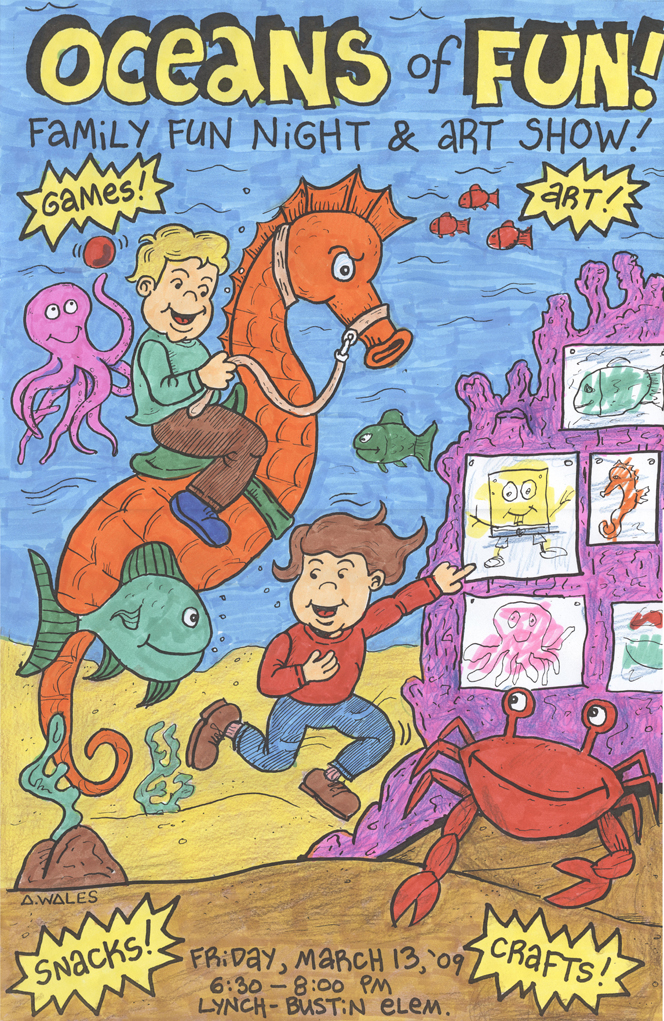
Oceans of Fun!

This is a poster I designed to advertise an upcoming event at the school where I teach.

Wednesday, January 14, 2009

Success Comes in Cans

-- not in "can nots"! They say that people who write their goals down are more apt to achieve them. I wondered, would it be possible to create an art lesson that encouraged children to set goals? I came up with "I-Can-Do-It Cans".

On the outside of the can, we drew ourselves with images that represented our goals. I told the kids that they were magic. If they wrote down what they wanted to achieve in sentences on slips of paper, and if they put them in the cans -- they just might come true!
You might think I was pulling their leg, but there's a lot of truth to this. I read a book once called Write it Down, Make it Happen by Hennriette Anne Klauser. This book explains the science behind why this is true.
There's a part of our brain called the reticular activation system,

Your reticular activating system is like a filter between your
conscious mind and your subconscious mind. It takes instructions from your
conscious mind and passes them on to your subconscious. For example, the
instruction might be, "listen out for anyone saying my name".

...you can deliberately program the reticular activating system by
choosing the exact messages you send from your consicous mind. For example, you
can set goals, or say affirmations, or visualize your goals.

Have you ever noticed that after you buy a car of a certain model and color of car, suddenly you see cars just like it everywhere. They were always out there, but now you notice them. It's the RAS that's involved there. Likewise, a mother can hear a baby cry from several rooms away and know whether it's her baby or not!

Why does writing your goals down make it more likely that you'll achieve them? In my own words, I guess what happens is that by writing your goals down, you're clarifying in your mind exactly what you want. Then the opportunities to get toward that goal stand out more clearly.

I know they say to set realistic goals, but I figure it doesn't hurt to write down things that might seem wildly implausible. I notice in my own I-Can-Do-It Can from years ago that I had drawn and written that I wanted to own a house. That seemed impossible due to financial circumstances at the time, but it's happened!
What goals will you set for this new year?

Thursday, January 8, 2009

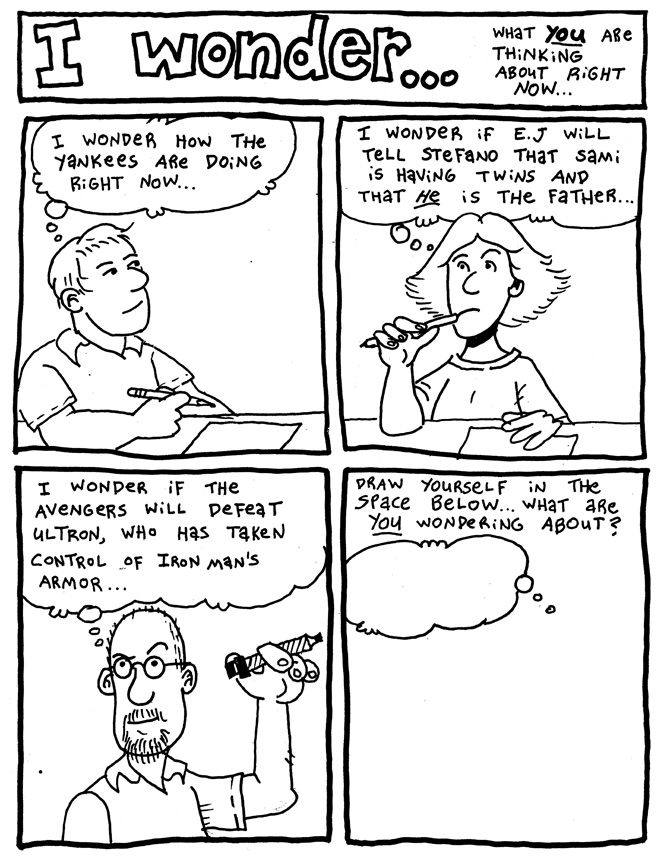
I Wonder


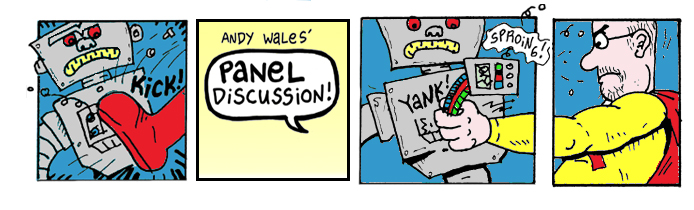
I created this quick one page comic and made copies to handout at a teacher inservice I was presenting a while back. It was our first activity -- an icebreaker. My goal was to get teachers thinking about how it can be so easy to want to just approach our classes with an objective and try to yank them out of where there thoughts currently are. Even teachers sometimes have their minds on other things! Are there some times when we can make good use of what our students are obsessing about as a writing or drawing prompt?

Wednesday, October 22, 2008

Oceans of Fun!


At school we are getting ready to kick off our Oceans of Fun unit of study. Helping to add to the excitement is Sponge-Bob Squarepants himself! To see how this absorbent fellow came to life, visit my School Page and check it out.

Thursday, September 11, 2008

Oviraptor's New Home

I was out walking yesterday and passed by this house. I could not believe what I saw. In the flower garden around their flagpole was one of the pariscraft sculptures the fifth grade students made last year! Each group draws names to see who gets to take their sculpture home, and evidently this orange oviraptor found a home right in someone's front yard. I must say this plaster sculpture painted in acrylic is holding up well!

Friday, September 5, 2008

Front Page News


A reporter from the Morning Times came to our classroom to see our recent acquisition of original sketches and signed poster from James Warhola. Click here to read the article online.

Thursday, August 21, 2008

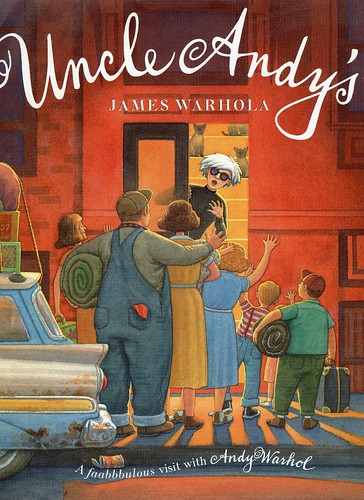
Uncle Andy's

I've been teaching art for over 20 years. I've always found art history to be fascinating. My students don't always agree with me, but I consider it a challenge to find ways to show them great art in a way that will catch their interest and spark their imagination. When I first started teaching, I I looked for artist biographies that were written for children that I could share with my students. They were few and far between. Now there are tons of them! The best one I've ever seen is a story about Andy Warhol called Uncle Andy's. Probably one reason it's so good is that it's written by Andy Warhol's nephew, James Warhola. James (an accomplished artist in his own right) writes about what it was like to go visit his famous uncle when he was a young boy. It's so neat to see this artist through a child's eyes. I read it to my fourth graders and they love it. Then we begin a unit of instruction learning about Pop Art, Warhol, and printmaking processes.

Well, here's where this post gets exciting! I asked my fourth graders if they'd like to write to the author and let him know how much we liked his book. They were excited to do that and we brainstormed together about what we wanted to put in the letter. I wrote their ideas on the board and they took turns writing on a single piece of paper. They also filled an envelope with drawings they made inspired by the book and some of their linoleum prints.

Mr. Warhola wrote back! My students won't know this until school starts, but he wrote a very lengthy hand-written letter answering our questions and telling us even more about his own art and writing and more about Andy Warhol. And that's not all -- Mr. Warhola sent us a signed poster and some original drawings -- working sketches for his next book. I can't wait to get these in a frame and hang them in the school.

One of the things kids find amazing about Andy Warhol when we read Uncle Andy's is that the artist had 26 cats all named Sam! James' next book is going to be about those cats! The working sketches he gave us are of a couple of those Sams. Uncle Andy's Cats will be coming out next summer. I can't wait!

One of our academic standards for art in PA is to teach kids the difference between original art and reproductions. Young kids sometimes are confused by this.

Mr. Wales: "This is a Picasso painting --"
First grader: (interupting) "Wow! How did you get ahold of it?"
Mr. Wales: "Well, actually it's a poster of the painting that he did."
First grader: "Well did he make it or not?"

And on and on it goes.


These gifts from Mr. Warhola will help teach that standard! I also like to stress to kids that artists don't just sit down and create masterpieces out of the blue. A lot of planning goes into creating a work of art, including sketching. Trial and error, making plans and refining. These little sketches are a glimpse into his process and something an actual original drawing the artist made.

We're starting our own gallery at Lynch-Bustin Elementary School! Last year we received a similar gift from artist James Gurney.

Monday, June 16, 2008

Sketchapalooza


In Curriculum Comics #1, I described our Sketchbook contest. Everyone who participates gets some kind of prize. Kids who just did a few drawings might get a free Big Mac at McDonalds. Those who do quite a few get larger prizes including art supplies or comics. The big winners' prizes this year were donated by McNamara's Office Supplies and Art Supplies. Here are just a couple of the top winners.

Tuesday, February 5, 2008

Fishing for Compliments


If you haven't caught on already, I am out to break any records set by artists for doing a lot of self-portraits. I believe I have passed Van Gogh, and have almost caught up with Rembrandt and Chuck Close.

Sometimes when my students are working, I sit down and do the assignment with them. For this project, I started by reading them the book Fish is Fish by Leo Lionni. If you haven't read this book, by all means do so. It is a classic. It's the story of a minnow and tadpole. The minnow grows into a fish, but is disappointed when his friend sprouts legs and leaves the pond. When his friend, now a frog, returns, he tells of a fantastic world outside the water. Based on his friend's descriptions, the fish imagines what this world must look like. His perceptions are limited by his own experience!


The illustrations are awesome, and the kids get all kinds of crazy ideas for unusual fish they would like to draw. I drew an art-fish, but we got all kinds. Next we color with crayons. But you can't color like a wimp -- you have to get mad at something. Imagine how you felt when your little sister broke that really cool thing you made out of Legos. Oh yeah, press down hard with those crayons.

We have to do this because we're using the technique of crayon resist. That's when you paint over the crayon drawing with watercolor paint. The waxy image keeps popping through the layers of paint. We painted blue over our fish and underwater scenes. The blue paint beads up on the thick crayon layers. All in all, it's a neat effect for pictures like these.

Saturday, December 8, 2007

The Dinosaurs that ate my Life


If you check this blog from time to time, you've probably noticed I haven't posted any comics work for a long time. That's because my time has been consumed with a really big project at school -- a Family Fun Night & Art Show I organize. It was finally held on November 30. I'm just beginning to get my life back! Here's one picture of a big dinosaur we made and one of our guests, but if you want to see a whole bunch of pictures, visit the Dino Daze Blog.