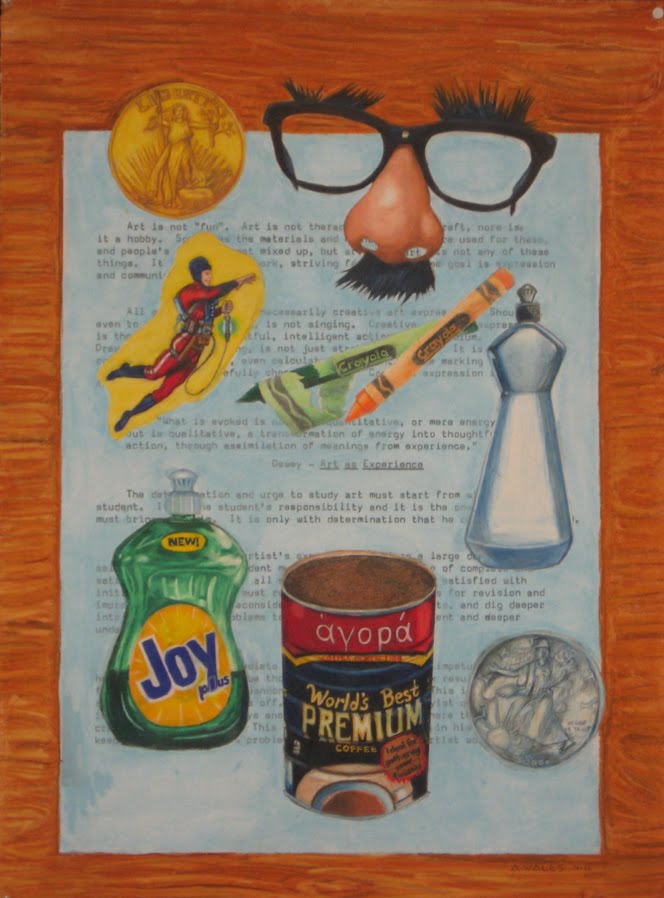
For this drawing, I took a Pop Art approach, which is a type of Appropriation art. I am inspired by artists like Rauschenberg, Rosenquist, and Lichtenstein who appropriated images from popular culture and recontextualized them.
To appropriate is to take possession of something. Appropriation artists deliberately copy images to take possession of them in their art. They are not stealing or plagiarizing. They are not passing off these images as their very own. Not at all. Appropriation artists want the viewer to recognize the images they copy, and they hope that the viewer will bring all of his/her original associations with the image to the artist's new context, be it a painting, a sculpture, a collage, a combine or an entire installation (Gersh-Nesic, 2011).
There are many different things you can do to an existing images to make them into original statements.
Strategies include "re-vision, re-evaluation, variation, version, interpretation, imitation, proximation, supplement, increment, improvisation, prequel... pastiche, paraphrase, parody, forgery, homage, mimicry, travesty, shan-zhai, echo, allusion, intertextuality and karaoke" (Pichler, 2009).
I see these kinds of images as a type of visual poetry. Like a poem, I take all these images together and say something. What does it mean? Does it take all the fun out of it if I spell it out? I don't know. Sometimes I explain what I was thinking, sometimes I try to give a little hint in the title and let you figure it out. For this time, I guess I'll spell it out for you.
I'm doing a series of drawings that feature unusual eyewear, like the 3-D glasses in
Secrets of Success. My idea is that what you get out of what you are facing depends on your outlook. You can choose that to some extent. I often see the goofy side of life, so I used the spectacles you see here to represent that. Look at what you are facing through the lens of imagination. All of these images go with that.
I wanted to superimpose this collection of images that might seem random at first over the text of something really boring. I found an old mimeographed handout from an art class. Let's just say I disagree with the professor, who begins with "Drawing is not fun" -- and goes on from there. To me this picture is about the experience of daydreaming when you are sitting in a boring class and everyone is going over the handout. Random thoughts come from all over the place. The text below each detail image is my unwritten guide to the Imaginative Life.

Are the mundane details of life getting you down? Try an imaginative outlook on life. A new pair of glasses can provide a new way of looking things -- and your new outlook may affect how others look at you.

Everyone's got something to say. Having trouble getting your point across? There may be some simple tools that you have overlooked. The solution you are looking for may have been under your nose the whole time. Using these familiar tools in new ways has a lot of appeal.

A good cup of coffee is a great way to wake up to the possibilities. Gather your faculties and begin!

We all have mundane tasks to perform. You can either do it the boring way, or the imaginative way.

Taking the imaginative approach to life will bring you new joy.

You will find that you will rise above the dreary aspects of life and accomplish great feats.

With the focal point and accessories drawn, I was ready to add the handout. I enlarged page to 18x24 at Staples, traced the objects through it and then cut out the shapes with an X-acto knife and glued it down.

Then I added the finishing touches with pastel.
 Beth Gersh-Nesic
 (2011). Art History Definition: Appropriation. http://arthistory.about.com/od/glossary_a/a/a_appropriation.htm
Michalis Pichler (2009).
Statements on Appropriation, published in Fillip #11 (2010), Vancouver
 These books are going to be writing journals/visual journals. Next we used watercolor paint to make some pages for the interior. Some of the favorite techniques of the day included salt technique, wet-on-wet, and painting with bubble wrap.

 Integrating art with other subjects is very important, especially today. The Learning Focused Schools (LFS) model is the current trend in education. One of the key ingredients for success in the studies they cite (Reeves, 2003) is the stress put on "cross-disciplinary curriculum integrating subjects currently downplayed (e.g. art, music)."
 Remember, according to Bloom's Revised Taxonomy, creativity is the highest order of thought! Eliminating creative projects from schools is just plain nuts! We need more of it, not less -- especially projects that help them make connections between disciplines.
 The picture above shows me trying to look "teacher-ish".